Key Points from the 2025 Annual Summit.
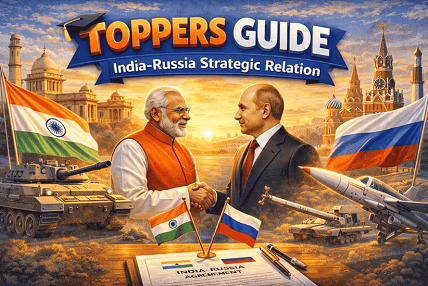
The India–Russia Annual Summit 2025, held in Moscow from 4th to 5th December 2025, has once again reaffirmed the deep and time-tested partnership between the two nations(india and Russia). Despite the rapidly evolving geopolitical landscape relation - marked by shifting alliances, economic uncertainties, and new global security challenges between two nations - India and Russia showcased strong continuity in their strategic engagement to overcome recent situations. The outcomes highlight a clear commitment to deepen cooperation in trade, defence, energy, industrial development, space, civil-nuclear technology, and labour mobility.
The summit’s significance goes beyond bilateral diplomacy. It sends a message that India and Russia are determined to preserve a strategic partnership built over decades, adapting it to global realities while expanding into new areas of collaboration. This long-standing partnership has been shaped by mutual trust, complementary strategic interests and consistent political commitment at the highest levels.
A Strategic Relationship Rooted in History and Evolving with Time
India and Russia have shared a unique diplomatic relationship spanning several decades with friendly partnership - from Cold War alignment to post-Soviet restructuring and now a multipolar world order. Over the years, the partnership has expanded across defence, nuclear energy, space technology, hydrocarbons, pharmaceuticals, education, and people-to-people ties.
In 2025, as global powers redefine their strategic priorities, India continues to pursue a multi-aligned foreign policy, maintaining engagement with all major powers—including the United States, European Union, Russia, and regional blocs. Russia, on the other hand, seeks to diversify trade partners and secure reliable markets amid geopolitical tensions and economic sanctions. In this context, the India–Russia Summit 2025 serves as an anchor for stability and new opportunities.
Boosting Bilateral Trade: Ambitious Target Set for 2030
One of the most important outcomes of the summit is the shared commitment to achieving a substantial trade volume target by 2030. While both nations are yet to announce the final figure officially, discussions indicate an ambitious goal aimed at significantly surpassing the current trade volume.
Why Trade Expansion Matters?
India’s imports of crude oil, coal, fertilisers, and defence equipment from Russia have grown exponentially in recent years. and approximately 60 billion US dollar trade between two nations.
Russia seeks stable long-term buyers for energy and raw materials to boost their economy and stable leadership in the world order.
India wants to balance its trade deficit by increasing exports in pharmaceuticals, textiles, machinery, tea, processed foods, and IT services.
Both sides agreed to improve financial mechanisms, promote national currency trade, and simplify logistics through the International North–South Transport Corridor (INSTC) and the Chennai–Vladivostok Maritime Corridor. These connectivity projects are expected to drastically reduce transportation time and cost, boosting commercial exchanges.
Defence Cooperation: Continuing a Legacy, Expanding New Frontiers
Defence has been the cornerstone of India–Russia relations for decades. The 2025 summit once again emphasised continuity and expansion in this crucial pillar. For example the defence deal of Brahmos missile.
Key Defence Highlights of the Summit
Continued cooperation in defence manufacturing under Make in India with cooperation of Russia.
Collaboration on advanced technologies exhange, including air defence systems, combat aviation, submarines, and armoured vehicles.
Joint production and maintenance facilities for platforms already used by the Indian Armed Forces.
Strengthening of military-to-military exchanges and joint exercises.
Despite India diversifying its defence imports and Russia expanding its clientele, both nations recognise the enduring value of their partnership. India benefits from technology transfer, cost-effective equipment, and long-term maintenance support, while Russia sees India as a major strategic defence partner in Asia.
Energy Collaboration: A Central Pillar of the 2025 Agenda
Energy emerged as a major focus of discussions at the summit. India, being one of the world’s largest energy consumers, and Russia, a top energy exporter, are natural partners in this domain.
Civil-Nuclear Agreement Expansion
India and Russia agreed to accelerate cooperation in civil-nuclear energy, particularly:
Development of additional units at the Kudankulam Nuclear Power Plant.
Joint research in nuclear safety and advanced reactors.
Possibility of cooperating in nuclear energy projects in third countries.
Hydrocarbon Investments
The two sides also discussed:
Increasing Indian investments in Russian oil and gas fields.
Enhancing long-term crude and LNG supply commitments.
Expanding cooperation in refining, petrochemicals, and energy transportation.
This strengthened energy partnership is expected to support India’s energy security goals while helping Russia maintain stable markets.
Industrial & Technological Collaboration: Paving the Way for a New Era
A major thrust of the summit was on diversification of economic cooperation beyond traditional sectors.
Key Industrial Focus Areas
1. Shipbuilding & Maritime Cooperation
India and Russia aim to:
Develop co-production facilities.
Enhance Indian shipyards with Russian technology.
Collaborate on Arctic shipping routes and maritime logistics.
2. Manufacturing & Heavy Industries
Joint initiatives may include:
Machinery manufacturing
Metallurgy and mining
Automotive components
Industrial automation
3. Digital Technologies & Innovation
Both sides acknowledged the importance of:
IT services
Cybersecurity cooperation
Space technology
Joint innovation centres
Start-up ecosystem partnerships
This opens new opportunities for Indian private businesses and MSMEs.
Labour Mobility: A New and Important Dimension
One of the lesser-discussed but highly significant outcomes of the summit is the plan to strengthen labour mobility arrangements. India and Russia are exploring frameworks that would:
Facilitate skilled Indian workers to find employment in Russian industries.
Address Russia’s labour shortages in sectors like construction, IT, healthcare, and manufacturing.
Ensure safe, legal, and structured migration channels.
This could emerge as a major geopolitical and economic advantage for India, which has a young workforce ready to explore global opportunities.
Geopolitical Importance: Navigating a Changing World Order
The 2025 summit comes at a time when the world is witnessing:
Increasing tensions between major powers
Shifting alliances in Europe and the Indo-Pacific
A push towards multipolarity
Economic realignments due to sanctions and conflicts
India’s balanced diplomatic approach and Russia’s strategic pivot towards Asia make their partnership even more relevant. For India, the relationship supports:
Defence diversification
Energy security
Technology access
Strategic autonomy
For Russia, India remains a trusted partner, a major market, and a bridge to the wider Global South.
Challenges Ahead: Addressing Key Concerns
While the engagement remains strong, several challenges need attention:
Payment settlement issues due to global sanctions
Logistics inefficiencies
Need for greater diversification of trade
Balancing India’s ties with Western partners
Russia’s deepening relations with China
Both sides, however, appear determined to navigate these complexities with a pragmatic approach.
Conclusion: A Partnership Ready for the Future
The India–Russia Annual Summit 2025 reaffirms that the strategic partnership is not only alive but evolving to meet new challenges and opportunities. The focus on:
Trade expansion
Defence technology cooperation
Civil-nuclear advancement
Energy security
Shipbuilding and industrial growth
Labour mobility
demonstrates a long-term vision shared by both nations.
As India aspires to become a global economic powerhouse and Russia seeks stable alliances in a turbulent world, their strategic engagement stands as a model of resilience and mutual benefit. The commitments made at the summit will shape bilateral cooperation well into the next decade, offering fresh avenues for economic growth, technological progress, and strategic stability.
In a shifting global order, the India–Russia partnership continues to remain a pillar of strategic trust, geopolitical balance, and sustainable development.